How I Got a Texas Solar Company to 3x Their Calls in 90 Days
Marcus called me on a Tuesday afternoon in a pretty bad mood.
His solar installation company had been running for three years in the Houston area. Good reviews, solid work, reasonable prices. But his phone was averaging 8 calls a month from Google. His competitor two miles away, who he knew personally and whose work was not better than his, was visibly busier. Trucks in driveways all over the neighborhood. Marcus could not figure out why.
He had already spent money on a website. He had someone “do SEO” for him six months earlier. Nothing had changed.
When he shared his site with me, I could see the problems within the first ten minutes.
The Quick Answer
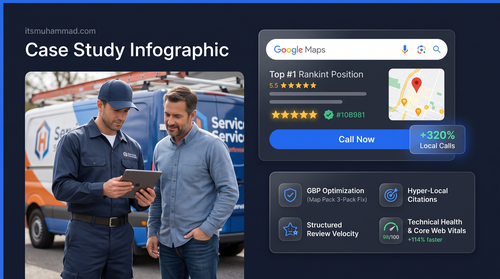
A slow website, an incomplete Google Business Profile, broken local citations, and zero location-specific pages were the four things killing this solar company’s visibility. Fixing all four over 90 days took their PageSpeed score from 38 to 96, pushed them to the number two position in the Google Map Pack for their primary service area, and grew their monthly calls from 8 to 32.
This solar company local SEO case study covers every step from the initial audit to the final results.
What I Found in the First Audit
I run every new client through the same audit process. Google Search Console data, PageSpeed Insights on mobile and desktop, Google Business Profile review, citation check across major directories, and a crawl of the site structure.
Here is what Marcus’s site showed:
Site speed was the first thing that stood out
His homepage took 6.2 seconds to load on mobile. His Largest Contentful Paint, which is basically the time it takes for the main content of a page to become visible to a visitor, was sitting at 5.8 seconds. Google considers anything above 2.5 seconds poor. His Cumulative Layout Shift score, which measures how much the page jumps around as it loads, was also failing. On a phone, his site felt broken.
His Google Business Profile was incomplete
He had claimed it, added his basic information, and stopped there. No service areas defined beyond his city name. No photos of actual work. No posts. No Q&A section. His business description was two generic sentences that mentioned solar panels and Houston.
That was it.
Local citations were a mess
Citations are the listings of your business name, address, and phone number across directories like Yelp, Yellow Pages, and dozens of other local sites. Marcus had 40 plus listings across various directories, and they were inconsistent. Three different phone numbers across different listings. Two different business name variations. One listing still had his old address from when he worked out of a different location.
Google sees these inconsistencies and loses confidence in which information is correct.
No location-specific pages
His website had a homepage, an about page, a services page, and a contact page. Nothing targeting the specific cities and neighborhoods where his customers actually lived. Not a single page mentions The Woodlands, Sugar Land, Katy, Pearland, or any of the other Houston suburbs where he regularly installed panels.
What I Fixed and In What Order
I always prioritize in the same way. Fix what is actively hurting you before building anything new. Speed and technical issues first, then GBP and citations, then new content.
Read how I approach technical speed fixes in detail in the Website Speed Optimization service section.
Step 1: Website Speed
The 6.2-second load time was the most urgent problem. A visitor searching for solar installers on their phone is not waiting that long. They hit back and call the next result.
I started with image optimization. His homepage had several large uncompressed images that were loading at full resolution. Converting them to WebP format and adding proper lazy loading brought the page weight down significantly.
Then I looked at his plugins. He had 19 plugins installed on his WordPress site, several of which were adding scripts to every page load, even when they were not needed on that page. Removing four unused plugins and deferring the scripts from three others made a noticeable difference.
His hosting was also contributing to the problem. His server response time was over 800 milliseconds before a single byte of the page even started loading. I recommended and helped him move to a better hosting plan with the same provider. Server response time came down to under 200 milliseconds.
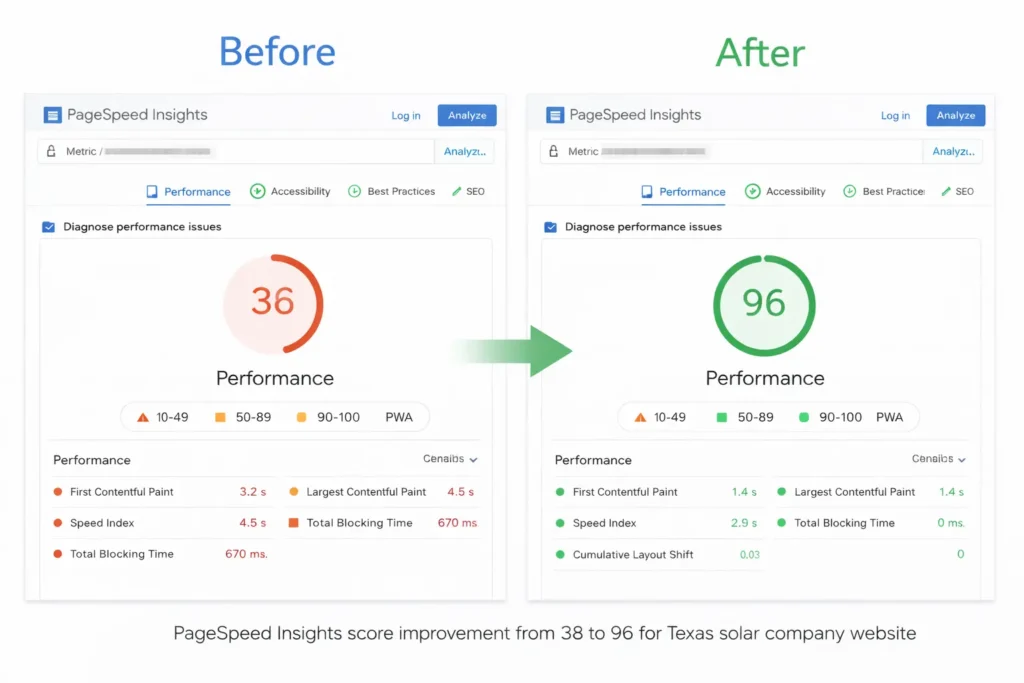
After these fixes, his PageSpeed mobile score went from 36 to 96. LCP dropped from 6.2 seconds to 1.4 seconds.
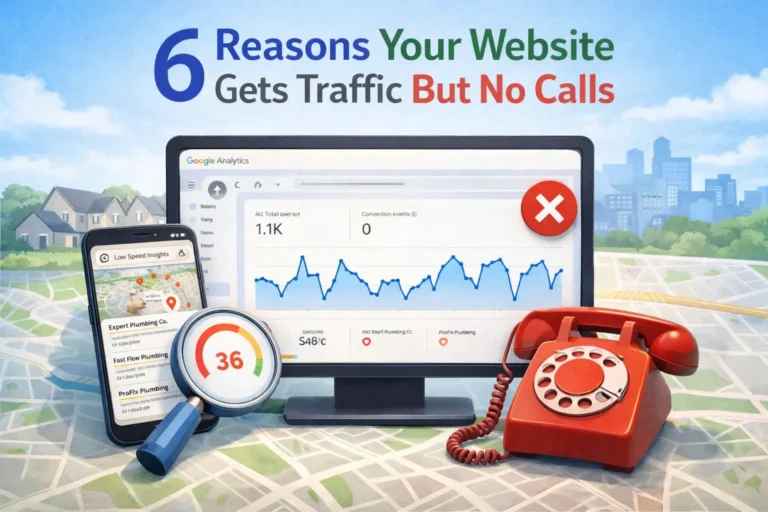
If your site is in a similar situation, I explain exactly what causes this and how to diagnose it in 6 Reasons Your Website Gets Traffic But No Calls.
Step 2: Google Business Profile
An incomplete GBP is like a shop with no sign outside. Google cannot confidently show it to people searching nearby because it does not have enough information to evaluate the business properly.
I rewrote his business description to include his primary service, his main location, and the specific areas he served. Not keyword-stuffed, just clear and complete.
I added 23 photos of actual completed installations. Before and after shots of rooftops, panel close-ups, inverter installations, and team photos on job sites. Real images from real jobs.
I defined his service areas properly, adding 14 specific cities and neighborhoods in the greater Houston area rather than just listing “Houston.”
I set up the services section within GBP, listing each service he offered with descriptions and rough price ranges where applicable.
I created his first four GBP posts covering seasonal solar incentives, a recent installation highlight, a response to a common customer question, and a profile of his team.
I also went through his existing reviews and made sure he had responded to every single one, positive and negative. Google sees review responses as a sign of an active, engaged business.
Step 3: Citation Cleanup
This is the unglamorous part of local SEO that most people skip because it is tedious. It matters.
I audited Marcus’s citations across 60 plus directories using a combination of manual checking and tools. I found 40 listings with some form of inconsistency.
The most common issues were the old phone number still appearing on 11 listings, the business name appearing as both “Marcus Solar” and “Marcus Solar Installations LLC” across different platforms, and the old address still appearing on 8 directories.
I updated every listing to match the exact business name, address, and phone number that appeared on his Google Business Profile. This process took several weeks because some directories require manual verification before changes go live.
Step 4: Location Pages
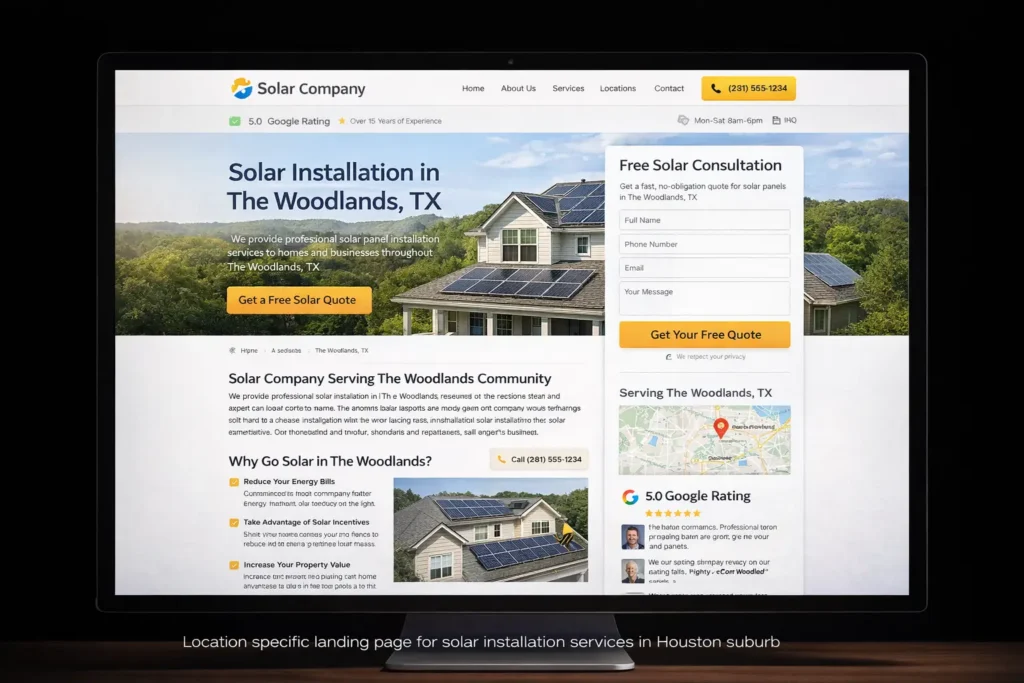
Once the foundation was solid, I built five new pages targeting the most important suburbs in Marcus’s service area. The Woodlands, Sugar Land, Katy, Pearland, and Clear Lake.
Each page followed the same structure. An introduction mentioning the specific area and why solar made sense there. Information about local solar incentives or utility providers relevant to that area. A section about Marcus’s experience working in that neighborhood. Real photos from jobs done in or near that area, where possible. A clear call to action with his phone number.
These pages were not long. Around 600 to 700 words each. But they were specific, genuine, and targeted.
The Results After 90 Days
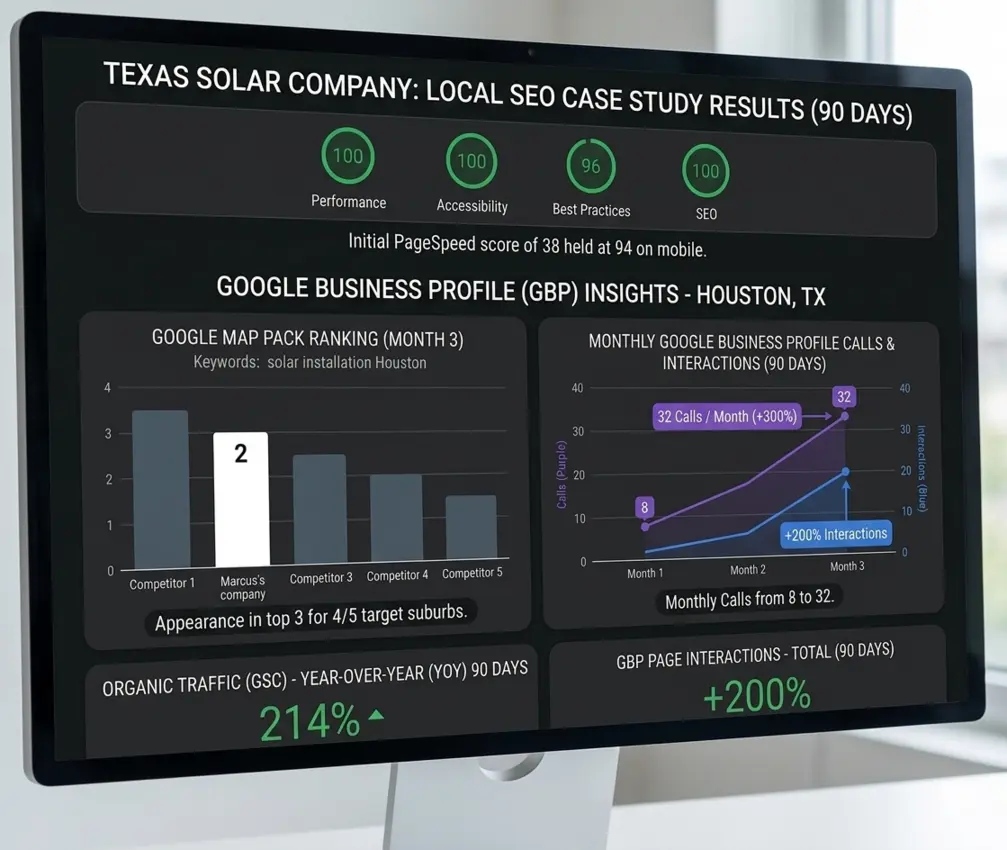
Marcus’s Google Business Profile interactions increased by more than 200 percent in the first two months. By month three, he was ranked number two in the Map Pack for “solar installation Houston” and appeared in the top three for four of his five target suburbs.
Monthly calls from Google went from 8 to 32.
His PageSpeed score held at 94 on mobile three months after the initial fixes, which tells me the improvements were structural rather than superficial.
Organic traffic from Google Search Console showed 214 percent growth compared to the same 90-day period the previous year.
What This Took in Real Terms
I want to be honest about what this involved because I think it helps set realistic expectations.
The speed fixes took about a week of active work spread across two weeks of testing and monitoring.
The GBP work took roughly 10 hours across the first two weeks, then ongoing monthly maintenance of about 4-6 hours per week for posts and review responses.
The citation cleanup took the longest in calendar time because of directory verification delays. Active work was maybe 20 hours total but spread across 6 weeks.
The location pages took about 4 hours each to research and write properly, so 20 hours total across two weeks.
None of this is mysterious. It is methodical, unglamorous work done consistently. That is what local SEO actually is.
What You Can Take From This
If you run a service business and your phone is quieter than it should be, the four things that hurt Marcus are the same four things I see on almost every service business website I audit.
Check your mobile PageSpeed score at pagespeed.web.dev. If it is below 70, that is your first priority.
Log into your Google Business Profile and count how many fields are incomplete. If you have not added photos, service areas, services, and posts, you are leaving visibility on the table.
Search for your business name in a few different directories and check that your name, address, and phone number are identical everywhere.
And look at whether you have any pages targeting the specific cities and neighborhoods where your customers live, not just your main city.
If you want to see exactly what’s included in each service, check out my Local SEO service.
If you want me to look at your specific situation, I offer a free audit that covers all four of these areas. You can learn more about how I work on my about page, or get in touch through the contact page.