How to Rank on Google Maps in Saudi Arabia
I work with businesses across Riyadh, Jeddah, and Dammam that want to rank on Google Maps in Saudi Arabia, and the same question comes up almost every time. “We’re on Google Maps, so why aren’t we showing up when people search?”
Being listed and being visible are two different things. A lot of Saudi service businesses have a Google Business Profile set up, but nobody optimized it for how Google actually decides who shows up in the map pack.
Here’s exactly how I approach it.
Quick Answer: How Do You Rank on Google Maps in Saudi Arabia?
You rank on Google Maps in Saudi Arabia the same way you would anywhere else: by strengthening relevance, distance, and prominence. But the details matter more here because search behavior is hyper-local. That means an Arabic-and-English optimized profile, hyper-local district targeting instead of just “Riyadh” or “Jeddah,” consistent NAP across local directories, and steady review generation.
Why Local SEO in Saudi Arabia Works Differently
Search behavior here leans heavily on location and trust. Someone searching for a service in Al Olaya isn’t typing “cleaning company Riyadh.” They’re searching in a way that’s specific to their neighborhood, sometimes in Arabic, sometimes in English, sometimes mixing both.
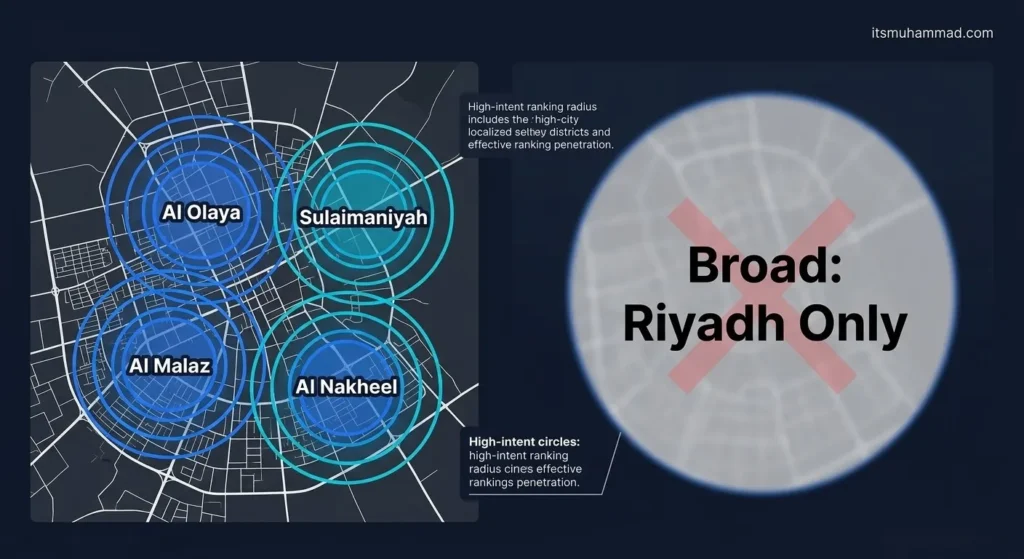
Google’s map pack algorithm rewards businesses that clearly signal where they actually operate and what they actually do. A profile that says “Riyadh” and nothing more is competing against every other business in a city of over 7 million people. A profile that clearly signals coverage of Al Olaya, Sulaimaniyah, and Al Malaz is competing in a much smaller, much more winnable pool. That is the core advantage when you rank on Google Maps in Saudi Arabia with district-level precision.
The 6-Step Fix to Rank on Google Maps in Saudi Arabia
Step 1: Set your Google Business Profile category correctly
Pick the most specific primary category available, not the broadest one. A business offering AC maintenance should be categorized as an “HVAC contractor,” not a general “contractor.” This single setting affects which searches Google considers you relevant for.
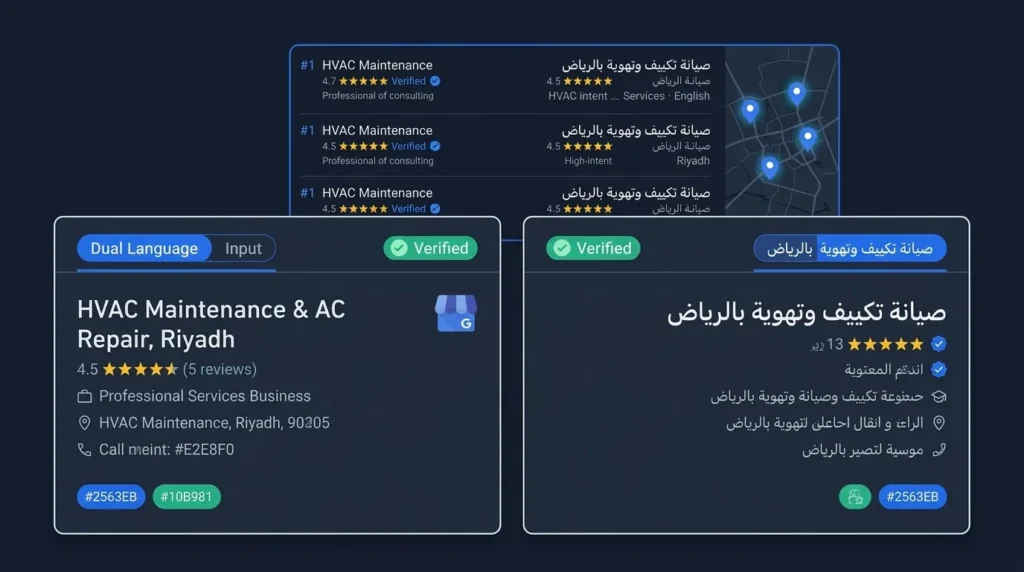
Step 2: Add both Arabic and English business information
Google Business Profile supports adding your business name, description, and services in multiple languages. If most of your customer base searches in Arabic, and your profile is only in English, you’re leaving visibility on the table.
Step 3: Define your service area with real district names
Instead of just listing “Riyadh,” define coverage using actual district names: Al Olaya, Sulaimaniyah, Al Malaz, Al Nakheel. Do the same for your website content. This is one of the highest-leverage changes I make for clients here, and it’s often skipped entirely.
Step 4: Build local citations on Saudi-relevant directories
Beyond Google, list your business consistently on regional directories and platforms that Saudi customers actually use, alongside standard ones. Every listing needs to match your Google Business Profile exactly: same name, same address format, same phone number.
Step 5: Generate reviews consistently, not in bursts
A pattern I see often is a business collecting 20 reviews in one week after a push, then nothing for six months. Google’s algorithm responds better to a steady, ongoing pattern of new reviews than to a single spike.
Step 6: Publish location-specific content on your website
A single generic “Services” page won’t carry much weight for multiple districts. Dedicated, genuinely useful content for each major area you serve gives Google more to work with when matching you to hyper-local searches.
A Pattern I See Often in This Market
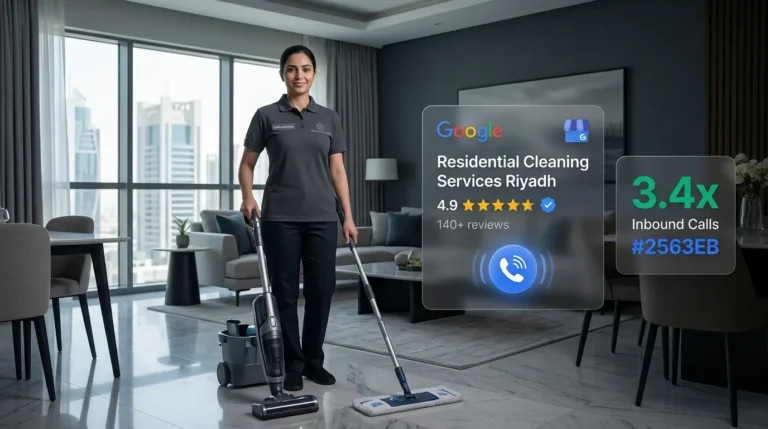
Whether it’s an HVAC company off a main road in Riyadh, a dental clinic near a well-known landmark, or a cleaning service covering the Sulaimaniyah area, the underlying local SEO problem is almost always the same: a profile that’s technically set up but never optimized for how specific Google needs the signals to be.
Once the category, language, service area, and citation consistency are fixed together, visibility improvements tend to build over a period of weeks to a couple of months, depending on how competitive the specific district and industry are.
If you want a clearer starting point, start with this Google Business Profile fix before layering on the rest of the strategy.
What Makes This Different from Ranking in the US or UK
In markets like Houston or London, competition is often about content depth and backlinks. In Saudi Arabia, especially in Riyadh and Jeddah, the gap is more often basic setup: missing Arabic content, vague service areas, inconsistent citations. That means the early wins here tend to come faster once the fundamentals are actually in place, because fewer competitors have done the work properly yet.
If You Want a Second Opinion on Your Setup
If your business is listed on Google Maps but not showing up where it should, I’m happy to take a look. Free audit, no pressure, just an honest read on what’s holding your profile back in this specific market.
Frequently Asked Questions
The Bottom Line
Learning to rank on Google Maps in Saudi Arabia isn’t about a different algorithm. It’s the same relevance, distance, and prominence factors Google uses everywhere, applied with more precision than most local businesses bother with.
To rank on Google Maps in Saudi Arabia, get the category, language, service area, and citations right together, and the rest tends to follow.
If you’d like help figuring out exactly where your profile is losing ground, I’m happy to take a look and give you an honest read.