Local SEO for Small Business: A Practical Guide 2026
Local SEO for Small Business: A Practical Guide
Your customers are already searching. Local SEO helps your business show up when people nearby need the services you provide.

You have a good business.
Your customers are happy. Your service is solid. You may even have a website and a Google Business Profile.
But there is one problem.
People nearby still can't find you on Google.
Meanwhile, another business shows up in the Map Pack whenever someone searches for your service.
This is where local SEO can help.
Local SEO is not about adding your city name to every sentence. It is about helping Google understand what your business does, where you serve, and why people should trust you.
For a small business, that can mean more visibility, calls, website visits, and customers.
- What Is Local SEO?
- Why Local SEO Matters for Small Businesses
- Local SEO vs. Regular SEO
- How Google Ranks Local Businesses
- 7 Things That Actually Improve Local SEO
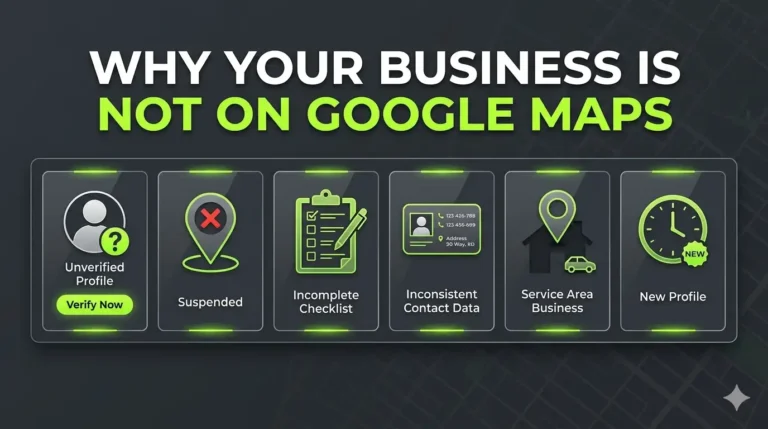
- Local SEO Problems Small Businesses Often Face
- Can You Do Local SEO Yourself?
- How Long Does Local SEO Take?
- How to Measure Your Local SEO Results
- Local SEO Checklist for Small Businesses
- What About LocalBusiness Schema?
- Does Local SEO Still Matter With AI Search?
- FAQs
What Is Local SEO?
Local SEO is the process of improving your online presence so your business can appear for searches related to your location.
For example, someone might search:
- plumber near me
- dentist in Austin
- appliance repair Albany
- best HVAC company in Phoenix
Google uses several signals to decide which local businesses are the best match.
Google says local results are mainly based on relevance, distance, and prominence .
Local SEO helps strengthen those signals.
It covers more than your website.
It can include your Google Business Profile , reviews, business information, local links, website content, and other online mentions.
Why Local SEO Matters for Small Businesses
A small business does not need to rank for every search in the country.
You need to be visible when someone nearby needs what you sell.
Think about a person with a broken water heater.
They probably aren't searching for:
“The history of water heater technology.”
They are searching for:
“water heater repair near me”
That search has clear buying intent.
If your business appears at the right moment, you have a chance to get the call.
This is why local search can be valuable for plumbers, roofers, dentists, electricians, restaurants, repair companies, lawyers, contractors, and many other local businesses.
Local SEO vs. Regular SEO
The two are connected, but they are not exactly the same.
| Regular SEO | Local SEO |
|---|---|
| Can target national searches | Focuses on local searches |
| Often targets broad topics | Targets services and locations |
| Organic rankings are central | Maps and local results matter too |
| Links and content are important | Reviews and local signals also matter |
| Location may not matter | Location can be critical |
For example, a national website might target:
“how to fix a leaking faucet.”
A local plumbing company may target:
“plumber in Dallas.”
The second search tells Google that location matters.
How Google Ranks Local Businesses
This is one area where many small business owners get confused.
There isn't a magic setting that guarantees the top position.
Google says local results mainly depend on three things:
Relevance
Does the business match what the person searched for?
Distance
How close is the business to the person searching?
Prominence
How well-known and trusted is the business?
A person searching for a roofing company should not get a dentist.
Your Business Profile and website should clearly explain what you offer.
Distance is also important.
This is one reason local rankings can change from one neighborhood to another.
A business can rank well in one part of a city and poorly in another.
Google can use information such as links, reviews, and other information available across the web when assessing prominence.
You cannot simply pay Google to move your business higher in local results.

7 Things That Actually Improve Local SEO
Optimize Your Google Business Profile
Start here.
Your Google Business Profile is one of the most important parts of local search.
Make sure your information is complete and accurate.
Check your:
- Business name
- Primary category
- Address
- Phone number
- Website
- Hours
- Services
- Business description
- Photos
- Other relevant attributes
Google recommends keeping business information complete and up to date because accurate information helps Google match businesses with relevant searches.
But don't stop at filling out the profile.
Look at it from a customer's point of view.
If someone finds your business at 10 PM, can they tell whether you are open?
Can they see what services you offer?
Can they understand what makes you different?
Can they easily call you?
Make Your Website Clearly Local
Your website should make three things obvious:
What you do.
Where you do it.
Who you help.
For example, a roofing company shouldn't have a homepage that simply says:
“Welcome to ABC Roofing.”
That's not very helpful.
A clearer version might say:
“Roof Repair and Replacement in Denver, CO.”
Now the visitor and search engine have a much better idea of what the business does.
Include useful local information naturally.
- Service area
- City
- Neighborhoods
- Address, when appropriate
- Phone number
- Business hours
- Service pages
Don't turn the page into a wall of city names.
Write for customers first.
Build Pages Around Your Services
One common small-business mistake is putting every service on one page.
Imagine an HVAC company offering:
- AC repair
- AC installation
- furnace repair
- furnace installation
- duct cleaning
Putting everything into one giant page makes it harder to answer specific searches.
Instead, create useful pages for important services.
For example:
- /ac-repair/
- /furnace-repair/
- /duct-cleaning/
Each page should explain:
- what the service includes
- common problems
- who needs it
- what the process looks like
- service areas
- common questions
- how to contact the business
Don't create dozens of almost identical pages just by changing the city name.
If a location deserves its own page, give people real local information.
Get More Real Customer Reviews
Reviews matter for two reasons.
They help potential customers decide whether to trust you.
They also contribute to Google's local ranking systems.
But don't chase reviews just for a number.
A better goal is to build a simple review process.
- Ask the customer for feedback.
- Make the review process easy.
- Thank them for their time.
- Respond professionally to reviews.
Don't buy fake reviews.
Keep Your Business Information Consistent
Your business details should not look different everywhere.
Pay attention to your:
Name
Address
Phone number
This is often called NAP consistency.
Check important places where your business appears online.
That can include:
- Business directories
- Industry websites
- Local organizations
- Social profiles
- Review websites
If your old phone number is still listed on several important sites, fix it.
Consistency makes your business information easier to understand across the web.
Build Local Authority and Links
Links still matter.
But don't think:
“I need 500 backlinks.”
Think:
“Which websites would make sense for my business?”
A local plumber might earn a link from:
- a local business organization
- a community website
- a local news site
- a supplier
- a relevant industry organization
- a local event
That is much more natural than collecting random links from unrelated websites.
Local authority can also come from being mentioned in your community.
Sponsor something useful.
Take part in a local event.
Partner with another relevant business.
Create something local people actually want to reference.
Create Content People in Your Area Actually Need
You don't need to publish five generic SEO articles every week.
Start with real customer questions.
A pest control company might write:
“How to Tell If You Have Rats in Your Attic”
A roofing company could publish:
“How Much Does Roof Repair Cost in Dallas?”
An appliance repair company could create:
“Why Your Dryer Takes Two Cycles to Dry Clothes”
Notice something?
These aren't written for search engines.
They're written because customers actually have these problems.
That is the type of content worth creating.
Local SEO Problems Small Businesses Often Face
“I already have a Google Business Profile. Why am I not ranking?”
Having a profile is only the starting point.
Your competitors may have stronger relevance, more prominence, better reviews, stronger websites, or a better overall local presence.
Start by checking the basics.
Is your primary category correct?
Are your services clearly listed?
Does your website support what your profile says?
Are your reviews genuine and recent?
Is your business information accurate?
“My competitor has fewer reviews. Why are they above me?”
Local ranking is not a simple review-count contest.
Google considers multiple factors.
Relevance and distance also matter.
A business with fewer reviews can still be a better match for a particular search.
That's why looking at one ranking factor in isolation can lead you in the wrong direction.
“I added my city to every page. Why didn't that work?”
Because local SEO is not about repeating a location.
If every paragraph says:
“best plumber in Dallas”
it doesn't make the page better.
It can make the page harder to read.
Instead, explain your services clearly and use location information where it actually helps the customer.
“I built dozens of directory listings. Why didn't my rankings jump?”
Directories can be useful.
But they are not a magic button.
If your website is weak, your Google Business Profile is poorly optimized, your reviews are limited, and your service information is unclear, adding another directory listing may not solve the real problem.
Fix the foundation first.
Can You Do Local SEO Yourself?
Yes.
A small business with one location can handle many basic tasks without hiring an agency.
Start with:
The challenge is usually time.
If you're running a roofing company, you probably don't want to spend your evenings fixing technical SEO.
That's when outside help can make sense.
The right question isn't: “Can I do SEO myself?”
“Would doing it myself take time away from running my business?”
How Long Does Local SEO Take?
There is no honest answer like:
“You will rank in 30 days.”
Local SEO depends on your market, competition, website, business history, reviews, authority, and starting point.
A business in a small town may have a very different experience from a company competing in New York or Los Angeles.
Track progress over time rather than expecting one sudden jump.
Look for improvements in:
The final goal isn't a ranking screenshot.
It's getting more of the right customers.
How to Measure Your Local SEO Results
Rankings are useful.
They aren't the whole story.
For a local business, I'd watch four areas.
Visibility
Are you appearing for more relevant searches?
Traffic
Are more people reaching your website?
Actions
Are people calling, requesting directions, or contacting you?
And the most important one:
Are those visitors turning into real customers?
A ranking moving from position 8 to position 4 is nice.
But a ranking improvement that produces zero new business is not the result you really want.
Local SEO Checklist for Small Businesses
Use this as your starting checklist:
What About LocalBusiness Schema?
Schema can help search engines understand important information about your business.
Google supports LocalBusiness structured data for details such as business information and opening hours. Google recommends using the most specific local business subtype possible.
For example, a restaurant could use a more specific type than the generic LocalBusiness.
But don't treat schema as a ranking shortcut.
Correct structured data helps machines understand your page. It does not guarantee a rich result or higher rankings.
You can read Google's structured data guidelines for the official requirements.
Does Local SEO Still Matter With AI Search?
Yes.
This is an important point for 2026.
Google says the same basic SEO principles remain relevant for AI Overviews and AI Mode. There are no special requirements that guarantee inclusion in those features.
You can read Google's guidance on AI features and your website for the latest official information.
Google's newer guidance also stresses unique, useful, non-commodity content for generative search.
For a local business, that means your website should clearly answer real customer questions.
Don't write pages just because a keyword has search volume.
Write pages that make someone think:
“This is exactly what I needed.”
That's useful for traditional search.
It's also the right direction for AI-powered search.
Local SEO Is the Complete Picture
Local SEO isn't one trick.
It's the combined picture Google sees about your business.
- Your profile says what you do.
- Your website explains your services.
- Your reviews show customer experience.
- Your local mentions and links build credibility.
- Your content answers real questions.
- And your business information stays accurate.
Start with the basics.
Fix the things that are clearly wrong.
Then build authority over time.
You don't need to do everything this week. You need to do the right things in the right order.
Local SEO FAQs
What is local SEO for small businesses?
Local SEO helps a small business appear when people search for its products or services in a specific area. It includes your Google Business Profile, website, reviews, local content, business listings, and other local signals.
Why is local SEO important for small businesses?
It helps businesses reach people who are already searching for nearby products or services. Better local visibility can lead to more calls, visits, website traffic , and leads.
Can I do local SEO myself?
Yes. Many basic local SEO tasks can be handled by a business owner. The work becomes more difficult in competitive markets or when a business has multiple locations.
How long does local SEO take?
There is no fixed timeline. Results depend on competition, location, website quality, reviews, authority, and the business's starting point.
How do I rank higher on Google Maps?
Start with an accurate and complete Google Business Profile. Then improve your website, service relevance, reviews, local authority, and overall online presence. Google says local rankings mainly consider relevance, distance, and prominence.
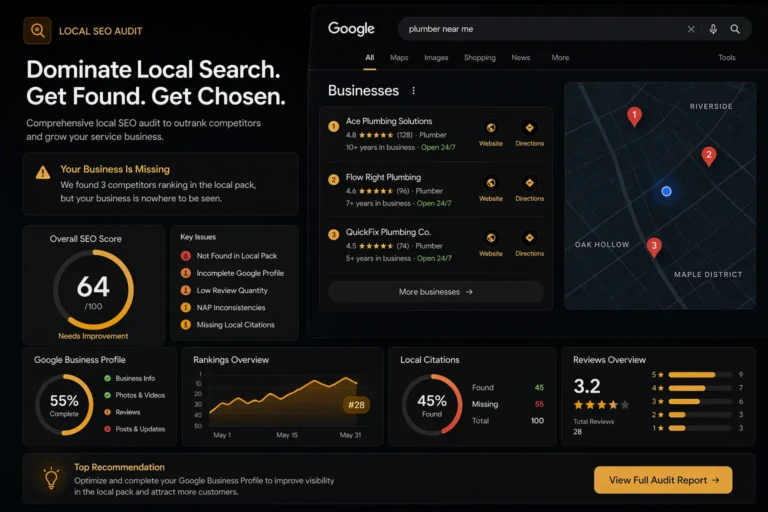
Not Sure Where Your Local SEO Stands?
A proper local SEO review can uncover weak service pages, missing local signals, inconsistent business information, technical issues, and opportunities your competitors are already using.
Get a Local SEO Review →